

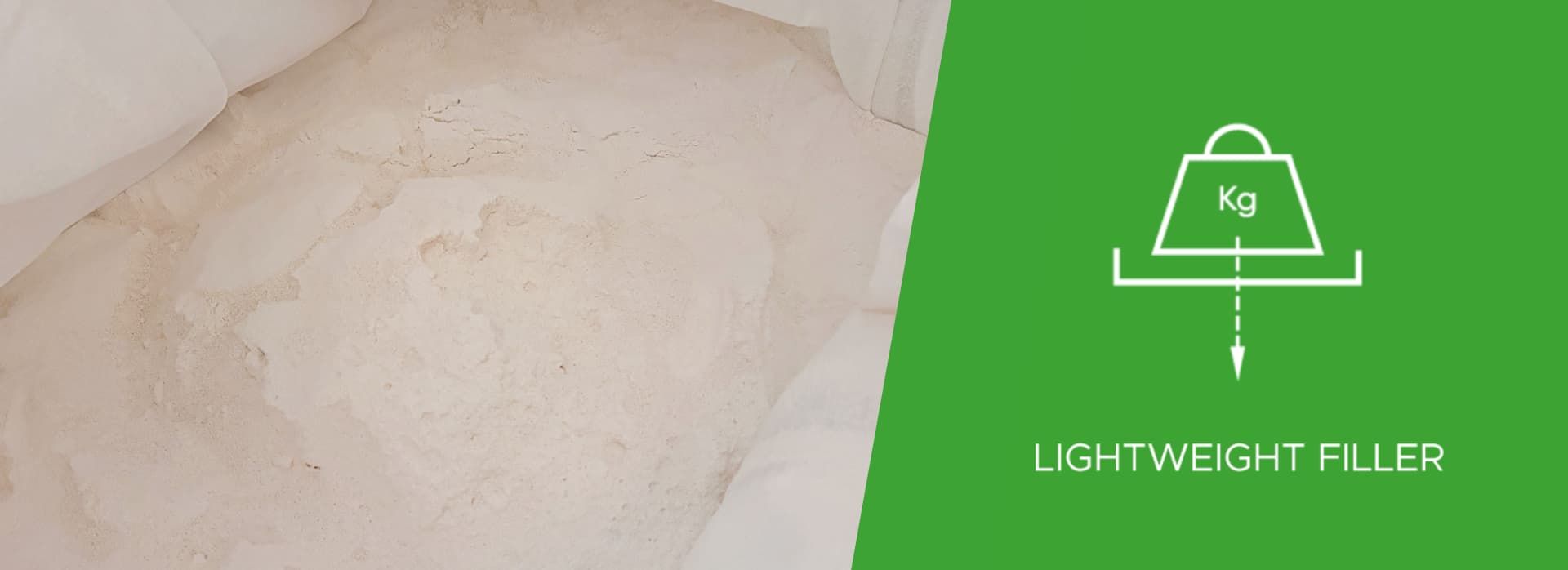
Density control, formulation and process stability in composites with lightweight mineral fillers.
Reducing the weight of a composite part is not simply a matter of replacing a conventional mineral filler with a lighter one. In industrial applications, the real challenge lies in maintaining the balance between final density, rheological behaviour, mechanical strength, dimensional stability, formulation cost and production repeatability.
Clades Composites develops lightweight mineral filler systems aimed at manufacturing composites with controlled density, adapting the formulation to the technical requirements of each application and to the manufacturer’s production process.
Beyond weight reduction: a matter of formulation.
In filled composites, final density does not depend solely on the type of mineral filler used. It is also influenced by factors such as the volumetric ratio of filler and resin, particle wetting, resin absorption, working viscosity, mixture dispersion, curing system and real manufacturing conditions.
In this type of formulation, it is not only the apparent density of the filler that matters, but also its behaviour within the resin-filler system. A lightweight filler may not deliver the expected result if it excessively modifies viscosity, makes dispersion difficult or alters the stability of the mixture during processing.
For this reason, lightweight fillers must be formulated from a technical perspective. It is not a question of incorporating a lightweight material in isolation, but of adjusting the complete system so that the final part maintains its functional performance and can be manufactured with industrial stability.
The solutions developed by Clades Composites allow work with different target density ranges, typically between 0.9 and 1.4 kg/l, depending on the type of part, thickness, geometry, polymer matrix and mechanical requirements of the final product.
Compatibility with different polymer matrices.
One of the distinguishing aspects of a Light Filler system is its ability to adapt to different resin matrices. The formulations can be integrated into systems based on polyester, vinyl ester, acrylic or epoxy resins, always previously adjusting compatibility, dispersion and processing behaviour.
This point is particularly important because each matrix has different viscosity, curing kinetics, shrinkage and wetting capacity. A filler that performs correctly in a polyester matrix will not necessarily offer the same behaviour in an epoxy or acrylic matrix unless the formulation is adjusted.
For this reason, we develop lightweight mineral fillers as adaptable technical solutions, not as a single standard reference.
Control of viscosity, dispersion and mould behaviour.
In industrial manufacturing, a mineral filler must not only reduce weight. It must also allow the mixture to be processed correctly.
A poorly adjusted lightweight formulation can generate problems such as excessive viscosity, poor dispersion, entrapped air, sedimentation, loss of flow, surface defects or density variations between batches. In the plant, small variations in viscosity or dispersion can lead to significant differences in mould filling, surface finish or final density.
To prevent this, it is necessary to balance particle size distribution, filler morphology, resin absorption level and the real proportion of solids in the mixture.
The objective is to obtain a paste or filled system with good workability, correct stability during processing and homogeneous behaviour when filling the mould, whether in casting, lamination, spraying, infusion or the manufacture of panels and lightweight parts.
Adjustable density according to application.
Not all parts require the same level of weight reduction. In some cases, the main objective is to reduce weight to improve handling and transport. In others, the aim is to optimise cost per volume, improve installation, reduce structural load or facilitate on-site assembly.
Clades Composites develops different families and formulation ranges:
▪ BPXX, as base lightweight solutions.
▪ LFXX, as formulations optimised for specific applications.
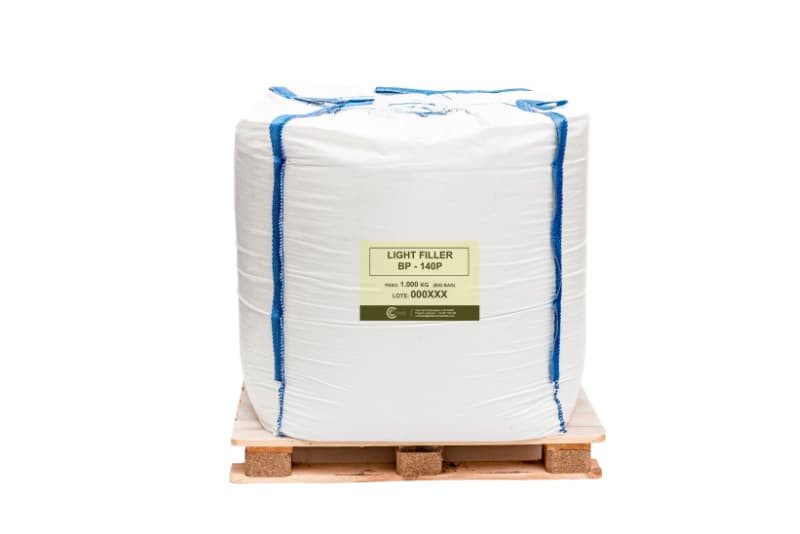
▪ Concentrates, for fine density adjustment and adaptation to systems where the manufacturer wishes to combine the Light Filler with other local mineral fillers or fillers already used in their process.
This approach makes it possible to define the final density of the composite according to the required balance between lightness, strength, cost, surface finish and productivity.
Industrial applications.
Lightweight mineral fillers are particularly interesting in sectors where mass reduction provides direct advantages without requiring a complete redesign of the production process.
Their main fields of application include:
▪ Solid Surface and technical surfaces
▪ Sanitary ware, shower trays, bathtubs and moulded elements
▪ Industrial construction and precast elements
▪ Lightweight panels and architectural components
▪ Marine applications and parts where weight affects final performance
▪ Automotive, transport and technical components
▪ Swimming pools, spas and technical furniture
▪ General composite industry
In all these cases, the key is to adapt the formulation to the customer’s real process, not the other way around.
Technical treatment of the filler and system stability.
The lightweight fillers developed by Clades Composites incorporate chemical and thermal adjustment processes aimed at improving system stability, dispersion quality and repeatability of the final product.
This treatment makes it possible to work with more stable formulations, improve integration with the polymer matrix and reduce variations during manufacturing. In industrial production, this point is critical: weight reduction is only useful if the manufacturer can reproduce it consistently, batch after batch.
Technical advantages over conventional mineral fillers.
Compared with traditional mineral fillers, lightweight systems allow the density of the composite to be reduced while maintaining an appropriate balance between mechanical performance, processing behaviour and total manufacturing cost.
Their main advantages are:
▪ Significant weight reduction in the final part
▪ Technical adjustment of the formulation according to target density
▪ Good dispersion in resin
▪ Compatibility with different polymer matrices
▪ Improved workability and handling of parts
▪ Optimisation of logistics and production costs
▪ Possibility of incorporating recycled material
▪ Adaptation to existing industrial processes without major investments
A technical development, not a standard product.
Clades Composites’ Lightweight Filler technology is not conceived as a generic mineral filler, but as a tailor-made formulated system. Each application requires analysis of the target density, manufacturing process, type of resin, part geometry, mechanical requirements, surface finish and production conditions.
The result is a practical way to reduce weight without forcing the manufacturer to completely rethink its process. The key lies in adjusting the formulation so that density improvement does not compromise industrial stability or the performance of the final product.
At Clades Composites, we work as a technical partner in the development of lightweight formulations, helping each customer find the right balance between lightness, performance, cost and industrial feasibility.