

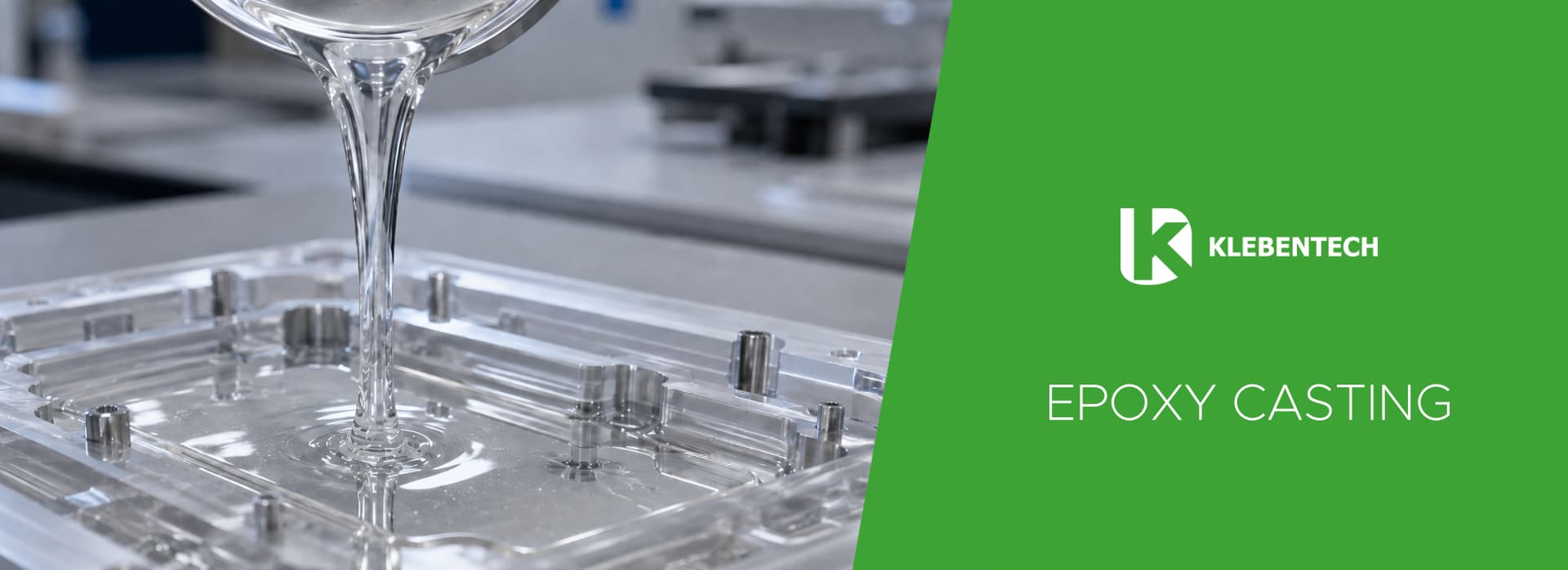
Epoxy casting resins: systems for encapsulation and technical parts.
Epoxy casting resins are designed for applications in which the material must be poured into a mould, cavity or technical housing to manufacture solid parts, encapsulations, prototypes or components requiring high dimensional stability.
Unlike other epoxy systems more commonly used for lamination, coating or bonding, an epoxy casting resin must perform correctly throughout the entire pouring process. It is not enough for the material to achieve good final hardness; it is also necessary to control its flow, heat generation during curing, shrinkage, air release, surface finish and the stability of the part once cured.
In this type of application, the system must be selected according to the casting thickness, total material volume, mould geometry, available working time, ambient temperature, required finish and the mechanical or thermal demands of the final component. The same resin may perform correctly in a thin layer but may not be suitable for a higher-volume casting if the reaction generates excessive exotherm or if the curing time is not adapted to the process.
One of the most important aspects of epoxy casting resins is exotherm control. During curing, the reaction between resin and hardener generates heat. When working with thick parts or large masses of material, this heat can accumulate inside the casting and cause defects such as bubbles, yellowing, cracking, deformation, internal stresses or loss of transparency. For this reason, systems for volume castings are usually formulated with more controlled curing kinetics, allowing the reaction to progress gradually and reducing the risk of overheating.
Low shrinkage is another technical advantage of epoxy systems compared with other resin families used in casting processes. In solid parts, moulds, models, encapsulations or technical components, excessive shrinkage can affect dimensional accuracy, generate internal stresses or cause separation from the mould, insert or substrate. Epoxy casting resins are therefore particularly suitable when geometric stability, accurate mould reproduction and a homogeneous surface finish are required.
Self-levelling capacity is also a key factor. A resin with good flow helps fill cavities, reproduce complex geometries and obtain uniform surfaces. This is important both in decorative applications, where the visual finish is part of the value of the piece, and in industrial applications, where the resin must properly surround inserts, sensors, connections, electrical elements or internal components.
In technical encapsulation applications, epoxy resin does not act merely as a filling material. Its function may be to protect components against moisture, dust, vibration, impact, chemicals or thermal variations. It can also provide electrical insulation, mechanical rigidity and stability against the working environment. For this reason, it is used in electrical components, technical modules, coils, sensors, connectors, lighting systems, functional prototypes and parts subjected to demanding conditions.
Depending on the application, the system can be formulated to provide high transparency, an opaque technical finish, higher hardness, improved thermal resistance, incorporation of mineral fillers or adaptation to specific processing requirements. In some cases, aesthetics and bubble-free appearance are prioritised; in others, mechanical strength, dimensional stability, service temperature or compatibility with functional fillers are more important.
HDT, or Heat Deflection Temperature, is a relevant parameter when the part will operate at temperatures above ambient conditions or when it is necessary to maintain rigidity and stability under specific thermal conditions. For this reason, epoxy casting systems are available with different HDT levels, allowing the formulation to be adapted to decorative parts, industrial components, moulds, tooling or technical encapsulations.
Epoxy casting resins are used in a wide range of industrial and technical applications: electrical and electronic encapsulation, manufacture of solid parts, prototypes, short production runs, moulds, models, tooling, transparent parts, industrial components with complex geometries, protection of inserts, systems loaded with mineral fillers and elements requiring low shrinkage and dimensional stability.
Their main advantages are:
- Low shrinkage during curing
- Good self-levelling capacity
- Excellent surface finish
- Dimensional stability
- Good performance in volume castings
- Possibility of working with different thicknesses
- Availability of systems with different HDT levels
- Compatibility with pigments, mineral fillers or technical additives
At Clades Composites, we supply epoxy systems for casting, encapsulation and the manufacture of technical parts, aimed at manufacturers, industrial workshops, product developers and companies requiring solutions adapted to their process. The system is selected according to the real manufacturing conditions: casting thickness, part volume, working time, required finish, service temperature, need for transparency, mould type and expected final performance.
The objective is to define an epoxy casting resin that enables stable, repeatable and technically suitable parts to be produced, avoiding common problems such as excessive exotherm, shrinkage, trapped bubbles, deformation or lack of dimensional stability.
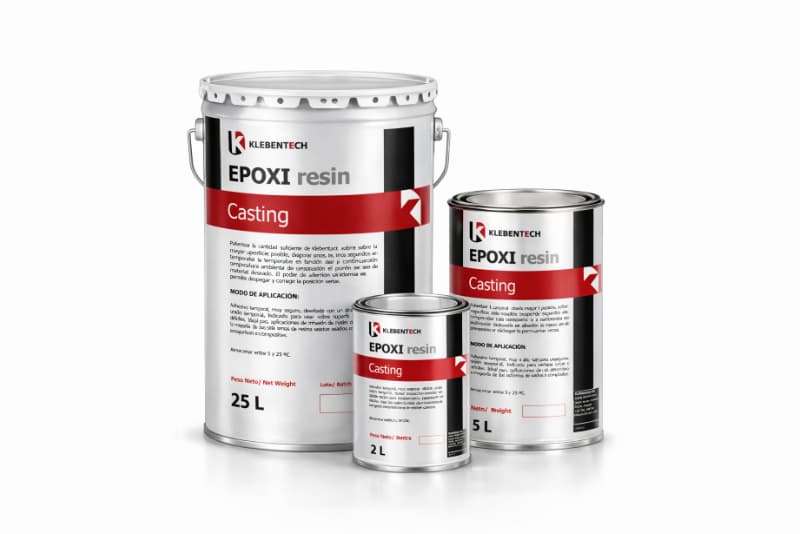
This line is integrated within KLEBENTECH, Clades Composites’ own brand specialised in high-performance technical systems for industrial applications, including epoxy casting resins, encapsulation, RTV systems and solutions for the manufacture of technical parts and specific components.