

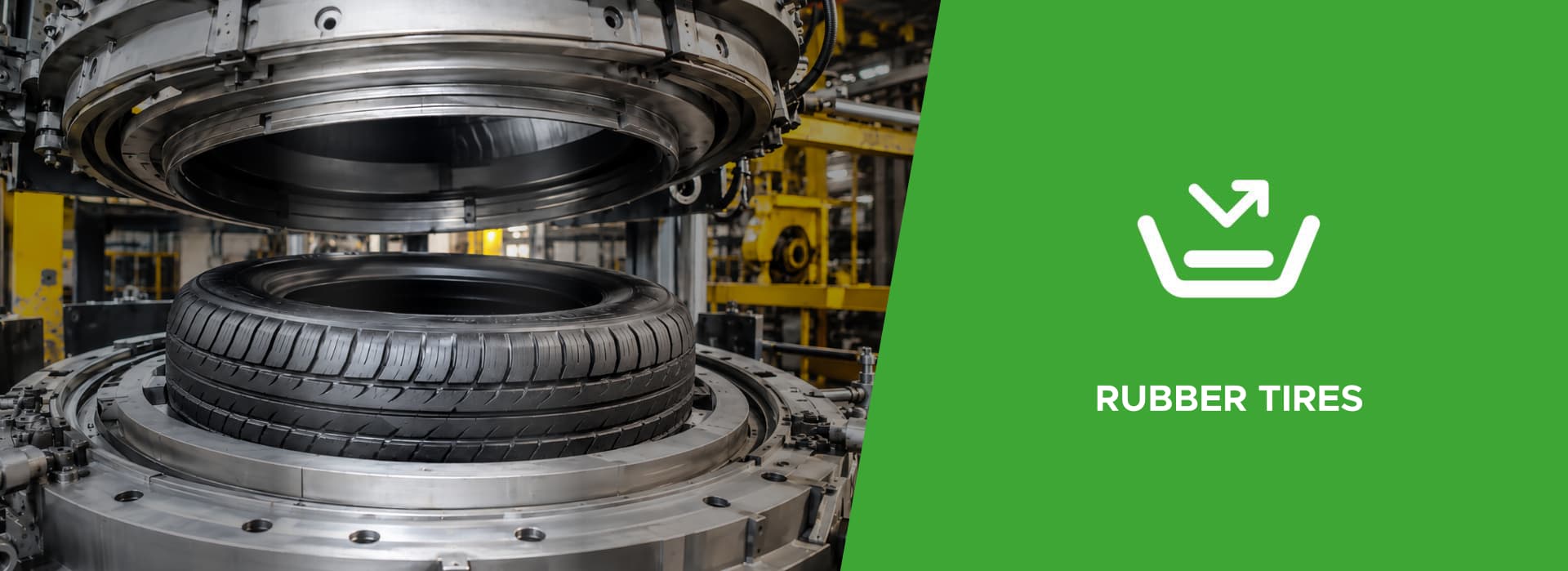
Tyre vulcanisation mould release: less transfer, less build-up and greater mould protection.
In tyre manufacturing, mould release should not be understood solely as the stage in which the vulcanised part is separated from the mould.
In intensive production processes, the release system has a direct influence on critical factors such as cleaning frequency, mould surface condition, part contamination, cycle-to-cycle stability and, ultimately, press productivity.
For this reason, assessing a release agent solely on its initial release capability provides an incomplete picture.
The really important question is:
How do the mould, the release agent and the tyre surface behave after multiple vulcanisation cycles?
The mould is also part of the process.
Moulds used in tyre manufacturing operate continuously under demanding conditions of temperature, pressure and contact with complex rubber compounds.
During vulcanisation cycles, residues originating both from the compound itself and from the release system used can accumulate on the surface.
The type of release agent can affect:
- ease of tyre removal
- definition of tread patterns and geometries
- surface uniformity
- cleaning frequency
- effective mould availability
- mould preservation during periods of inactivity
Conventional silicones: good release capability, but low durability and residue build-up.
In many tyre manufacturing processes, traditional silicone-based systems are still used.
These products provide release capability, but they operate as non-permanent systems, which means they require more frequent application.
Each new application introduces an additional amount of product into the process.
This can result in:
- higher consumption, up to four times greater
- more frequent reapplication
- greater product transfer to the part
- progressive build-up on the mould
- deposit formation
- greater need for subsequent cleaning of the tyre
In contrast, ABABOL semi-permanent systems are designed to form an invisible microstructure that remains stable and functional over multiple cycles.
The difference does not lie solely in the number of releases or in how easily the tyre can be removed.
It also lies in the amount of product required to keep the process stable.
Conventional silicones provide coverage levels of around 10–15 m²/L, whereas ABABOL semi-permanent systems can reach up to 45–50 m²/L, depending on application conditions, mould geometry and the vulcanisation process. This represents an important difference in terms of efficiency.
The real benefit is not simply using fewer litres or applying less product, but minimising transfer compared with conventional silicones and reducing build-up on both the mould and the part.
One of the most important factors in tyre vulcanisation is the transfer of the release agent.
Conventional silicone systems, because of their lower durability, higher amount of product per square metre and need for frequent reapplication, have a greater tendency to transfer and accumulate on the surfaces involved in the process.
This build-up can contribute to:
- formation of deposits on the mould
- surface contamination of the tyre
- risks during the first hours of tyre use
- progressive loss of cycle-to-cycle stability
ABABOL semi-permanent systems are formulated to work with minimal transfer, maintaining a functional film on the mould for a greater number of cycles.
The objective is to reduce both the amount of product that migrates and the amount that ultimately accumulates.
When the release agent changes the appearance of the tyre.
In addition to silicones, the rubber industry traditionally uses formulations containing functional solids such as:
- mica
- talc
- stearates
- other minerals or lubricating agents
These materials may improve certain release properties, but they can also transfer to the tyre.
One of the most problematic effects is the so-called pearlescent effect, particularly associated with formulations containing mica.
When these particles are deposited on the tyre surface, they can visually alter its finish and colour.
This may make additional operations necessary, including:
- cleaning
- washing
- surface conditioning
From a production perspective, these operations represent an additional cost for the tyre manufacturing process.
Mica-free ABABOL technology.
The technology developed by ABABOL addresses this issue through a proprietary system based on graphite, avoiding the use of mica.
Through a proprietary patented process, ABABOL semi-permanent systems use graphite as a functional solid.
Graphite provides the necessary lubrication and release properties without generating the characteristic pearlescent effect associated with mica.
This difference is particularly relevant in tyre manufacturing.
The objective is to facilitate mould release without changing the appearance of the part.
The use of graphite therefore helps to:
- avoid the pearlescent effect associated with mica
- preserve the tyre’s original colour
- minimise visual alteration of the surface
- reduce the need for subsequent washing
- reduce additional conditioning operations
This means releasing the tyre without introducing a new cleaning stage caused by the release agent itself.
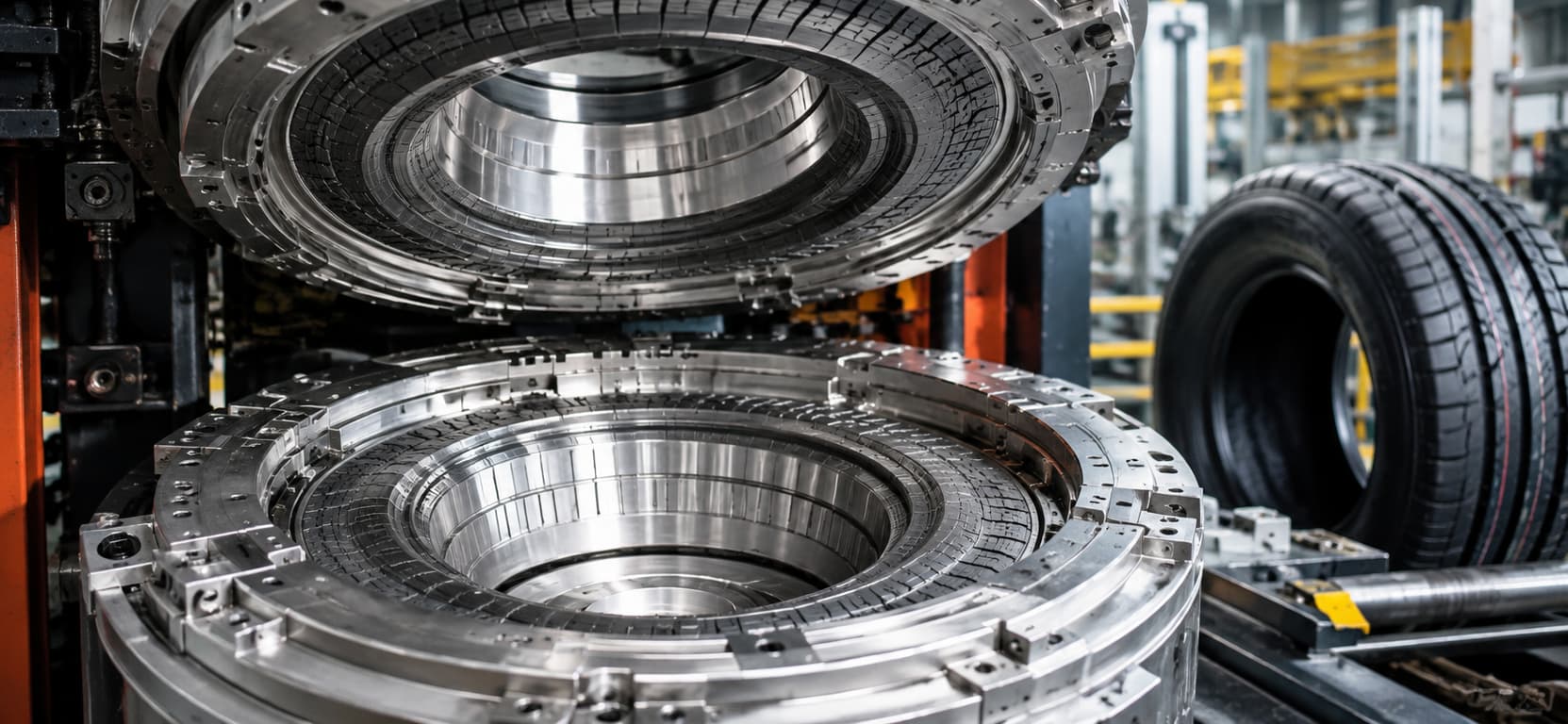
The problem of mould oxidation.
When a metal mould is exposed to certain environmental conditions, oxidation or surface corrosion can occur relatively easily.
This can progressively affect:
- surface finish
- release behaviour
- adhesion between rubber and mould
- residue build-up
- tooling service life
For this reason, an advanced mould release system should perform an additional function: protect the mould.
ABABOL systems developed for these applications include anti-corrosion protection, helping to preserve the metal surface after cleaning and during subsequent cycles.
This protection helps reduce progressive mould deterioration and improves its conditions for reuse.
Mould cleaning without mechanical aggression.
Mould cleaning is unavoidable in any vulcanisation process.
The issue is not only how often the mould is cleaned, but how it is cleaned.
Methods that are too aggressive may remove residues, but they can also affect the mould surface itself.
This is particularly critical in precision moulds, where engravings, channels, geometries and finishes must be maintained over long production periods.
In this context, ABABOL Dry Cleaner enables cleaning by spray-gun application, avoiding abrasive procedures that may damage the mould.
It can be used on metal moulds, including steel and aluminium applications, helping to remove residues without progressively degrading the surface.
The result is greater mould reusability and less damage associated with periodic cleaning operations.
Less cleaning thanks to a semi-permanent system.
The purpose of semi-permanent technology is not to eliminate maintenance completely. The objective is to reduce how frequently the mould needs intervention.
If the release agent:
- remains effective for more cycles
- provides lower transfer
- minimises build-up
- avoids pearlescent residues
- protects against corrosion
the need for cleaning can be significantly reduced compared with conventional systems requiring frequent application.
And every cleaning operation avoided means:
- less downtime
- less mould handling
- less surface aggression
- lower cleaning product consumption
- greater press availability
The real cost is not the price per litre.
In industrial tyre manufacturing, comparing products solely by their price per litre can be misleading.
The relevant parameter should be the total mould release cost per tyre produced.
To calculate this correctly, the following factors should be considered:
- surface area treated per litre
- application frequency
- number of cycles between applications
- amount of product transferred
- mould build-up
- cleaning frequency
- need for subsequent washing of the tyre
- press downtime
- mould service life
- product consumption
- process stability
From this perspective, the difference between a conventional silicone-based system and a semi-permanent system can be considerable.
A conventional non-permanent silicone may provide coverage of around 10 m²/L and require frequent applications.
An ABABOL semi-permanent system can reach up to 50 m²/L, remain functional over multiple cycles and operate with minimal transfer.
As a result: less product applied, less product transferred, less mould build-up and fewer interventions.
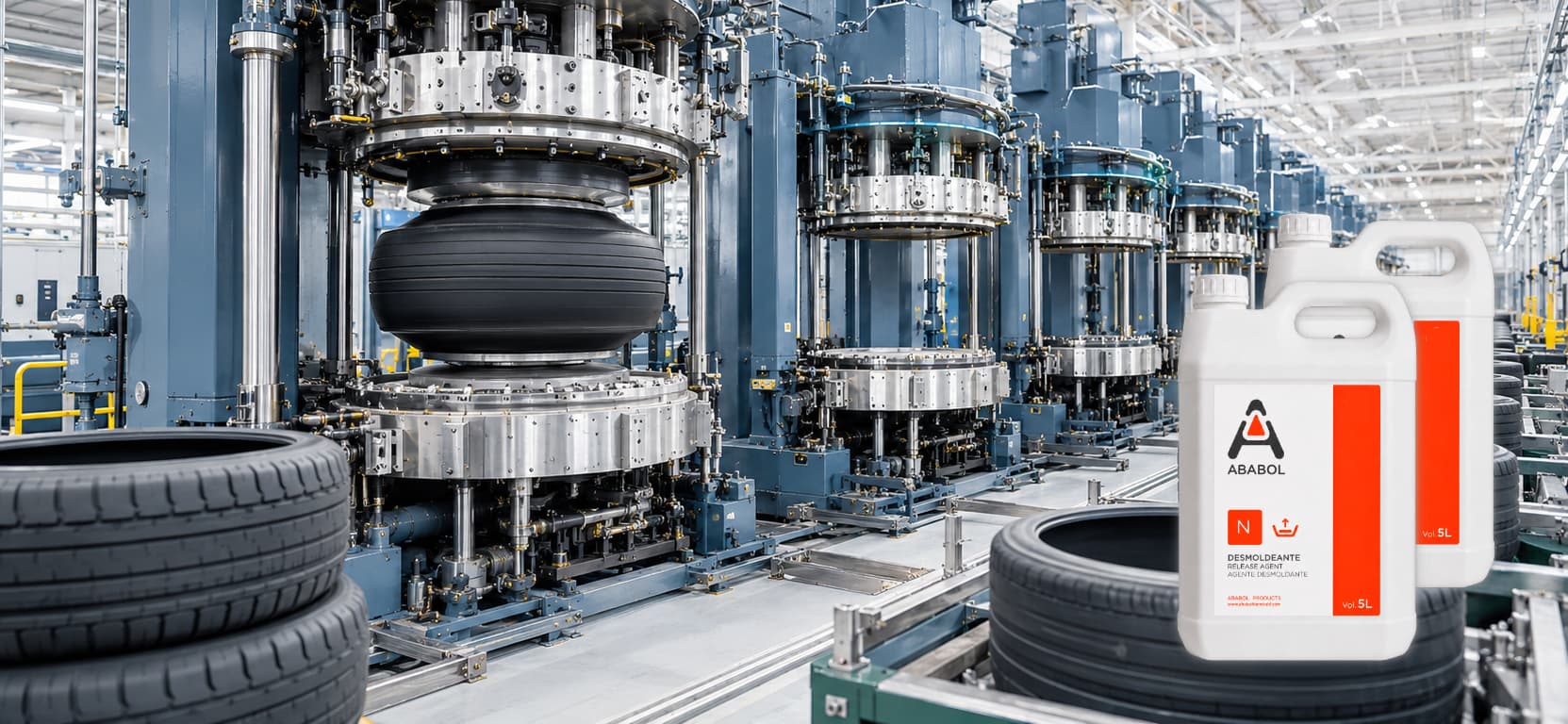
A mould release strategy specifically designed for tyre manufacturing.
ABABOL technology approaches the process through four complementary areas.
- Mould release.
High-coverage semi-permanent systems with greater durability than conventional silicone systems.
They enable faster and easier mould release compared with conventional systems.
- Transfer.
A film designed to operate with minimal transfer, reducing release-agent build-up on the mould and contamination of the tyre.
- Tyre surface.
For processes requiring the lubricating effect provided by certain fillers such as mica, talc, stearates and others, our graphite-based technology avoids the pearlescent effect and helps preserve the original colour of the rubber.
- Mould protection and maintenance.
Anti-corrosion protection and specific solutions such as ABABOL Dry Cleaner for cleaning operations while minimising damage to steel and aluminium moulds.
The objective of ABABOL semi-permanent systems is to ensure that the tyre comes out clean, residue build-up on the mould is minimised, the press requires fewer interventions and the vulcanisation process remains stable for the greatest possible number of cycles, thereby achieving maximum profitability in the production process.
Do you want to optimise mould release in your tyre manufacturing process?
Our technical team can analyse your current mould release process and recommend the most suitable ABABOL system for your application.
Less transfer. Less mould build-up. Longer cleaning intervals. Greater process stability.