

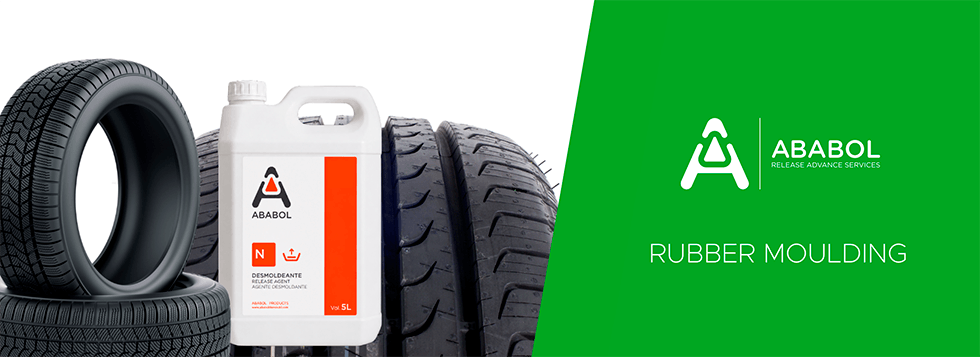
Water-based semi-permanent release agents for rubber and technical elastomers.
Rubber demoulding requires a treatment capable of maintaining its release properties under vulcanisation conditions and withstanding the mechanical stresses involved during part extraction. The elastomer formulation, fillers, curing system, part geometry and mould condition all influence the performance of the release film and its durability throughout the process.
At Clades Composites, we develop industrial release solutions under our ABABOL brand for different rubber and technical elastomer processing applications. The range includes water-based semi-permanent release agents designed to provide multiple releases per application, with different levels of release performance and lubricity depending on manufacturing requirements.
Release performance and lubricity during demoulding.
The release film acts as a barrier between the rubber compound and the mould surface. Its purpose is to prevent adhesion and facilitate part removal once the vulcanisation cycle has been completed.
Lubricity becomes particularly important in deep geometries, detailed features, cavities and areas that are difficult to demould. When excessive force is required during extraction, deformation, marks or tearing may occur even when the compound has been correctly vulcanised.
The treatment must also remain effective over successive production cycles. Operating temperature, continuous contact with the compound and friction during extraction gradually wear the release film, determining when reapplication is required.
For this reason, the performance of a release system should not be assessed only by its initial release capability, but also by its stability throughout consecutive production cycles.

Selecting the release agent according to the compound and process.
Selecting a release agent for EPDM, NBR, SBR, natural rubber or other elastomers requires an understanding of both the compound formulation and the actual processing conditions. The type of rubber alone does not determine all the requirements of the demoulding process.
The following factors should be considered when selecting a product:
- Compound and curing system: elastomer, fillers, additives and sulphur, peroxide or other curing systems.
- Moulding conditions: injection, compression or transfer moulding, operating temperature and cycle time.
- Mould surface: material, finish, condition and presence of residues or deposits.
- Part geometry: depth, detailed features, difficult-release areas and lubricity requirements.
- Subsequent operations: bonding, painting, surface finishing or specific surface cleanliness requirements.
In rubber-to-metal components, particular attention must be paid to where the release agent is applied. The treatment must facilitate removal from the mould without affecting the areas where adhesion must subsequently be maintained or created.

Transfer, build-up and cleaning frequency.
The evaluation of a release system should include both the condition of the moulded part and the evolution of the mould during production.
Excessive product transfer may affect subsequent operations, while residue build-up on the mould can alter the surface finish of the parts and increase the frequency of cleaning operations.
The amount applied and the uniformity of the release film are also part of the process. Applying more product does not necessarily result in more release cycles. Application conditions and the specified timings for each system must be respected to achieve stable performance.
During validation, it is advisable to record:
- number of cycles between applications;
- release agent consumption;
- ease of extraction;
- defects or marks associated with demoulding;
- surface finish of the parts;
- cleaning frequency;
- time spent on mould maintenance.
These data allow different systems to be compared using a more representative criterion than price per litre alone: the cost per conforming part and overall process stability.
ABABOL technology by Clades Composites for rubber and elastomers.
ABABOL is the industrial release solutions range developed by Clades Composites.
For rubber and technical elastomers, the range includes water-based, solvent-free semi-permanent formulations designed for different industrial processes. Applications include tyres, seals, conveyor belts, hoses, technical components, footwear and automotive parts, among others.
Within the range, ABABOL N is recommended for general rubber and elastomer applications. The most suitable grade should be selected according to the compound, moulding process and the level of release performance and lubricity required by each application.
Mould preparation also has a direct influence on system performance. Before applying the release agent, existing residues and deposits should be removed using a suitable cleaner.
Where the condition or porosity of the mould surface requires it, the use of a sealer can help improve film uniformity and treatment stability throughout successive production cycles.

We assess each application to define the release system.
At Clades Composites, we do not select a release agent based solely on the type of elastomer.
We assess each application by considering the rubber compound and its formulation, curing system, moulding process, operating temperatures, part geometry, mould condition and any difficulties encountered during extraction.
Based on this information, we define the most suitable ABABOL system and provide guidance on mould preparation, application conditions and the appropriate reapplication schedule.
A well-planned trial makes it possible to compare the current system with the proposed solution under real manufacturing conditions. Consumption, ease of extraction, part finish, number of cycles between applications, transfer and cleaning frequency are some of the parameters that can be used to assess performance.
The objective is not simply to make the part release from the mould. The aim is to establish a stable system adapted to the actual manufacturing process, helping maintain part quality while reducing the number of interventions required on the mould.
Tell us which rubber you use, how you process it and what difficulties you encounter during demoulding. Our technical team will assess your operating conditions to recommend the most suitable ABABOL solution and mould preparation procedure.